About Thomas "TJ" McKenna, Ph.D.
Dr. TJ McKenna is a Clinical Assistant Professor of Science Education and Program Director for AI & Education at Boston University's Wheelock College of Education & Human Development, where he also directs the Center for STEM Professional Learning at Scale — a hub supporting more than 17,000 educators across 29 states.
He has spent more than 20 years as a scientist, educator, and science communicator focused on a single question: what does it take to offer high-quality science learning to every student, at scale? His work sits at the nexus of policy, practice, and research, supporting teachers — pre-service and in-service — as they design authentic, meaningful STEM experiences.
He is the author of Making Sense of Sensemaking: Designing Authentic K–12 STEM Learning Experiences (Teachers College Press & NSTA Press, 2025), which reached #1 in STEM Education new releases on Amazon, and the founder of Phenomena for NGSS, a free resource that has served more than 5 million educators in over 100 countries. His current work explores how thoughtfully designed AI tools can support — rather than replace — teacher thinking, including the NGSS AI Coach, a curriculum coaching tool used by educators in more than 30 states.
"For me it goes back to this idea that everybody can do science, everybody has access to information. But it's about what we're going to do with it — what are we going to do with those science ideas?"
TJ McKenna, left, serves as moderator for a Q&A event with the co-hosts of the Discovery Channel’s “MythBusters” program, held in November at the Jorgensen Center for the Performing Arts. Click here for the link to the article.
Recognition & Current Work
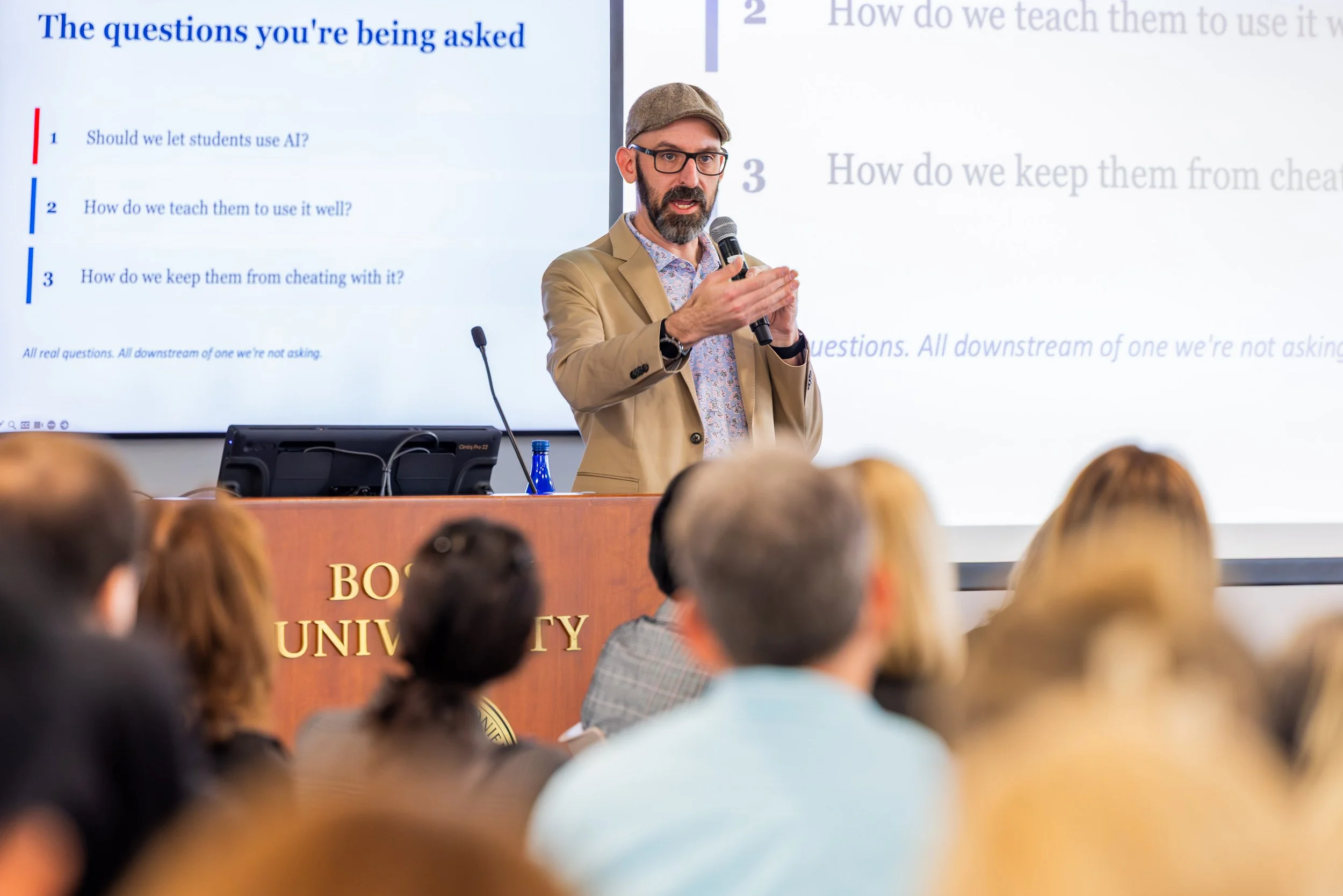
TJ is a Fellow of the International Society for the Design and Development of Education (ISDDE) and a member of its AI in Teaching and Learning Working Group, with recent convenings in Galway, Ireland, and Santiago, Chile. He was one of 60 scholars selected globally for the University of Cambridge's Workshop on Educational Dialogue, where he presented his work on AI-supported curriculum coaching. At Boston University, he received the 2026 Gerald and Deanne Gitner Family Award for Innovation in Teaching with Technology and the 2024 IDEAL Award for Curricular Innovation.
At BU Wheelock, TJ serves as Director of the Center for STEM Professional Learning at Scale, Program Director for AI and Education, Associate Director of Educator Engagement and Impact for the AI and Education Initiative, and Clinical Assistant Professor of Science Education, with an affiliated faculty appointment at the Rafik B. Hariri Institute for Computing. He is also co-director of NGSX (the Next Generation Science Exemplar System), serves on the OpenSciEd AI Advisory Group, and co-authored the OpenSciEd Design Specifications.
His writing on sensemaking and AI has appeared in Educational Leadership and Educational Designer, where he is guest editor of the Design for Joy special issue alongside colleagues at the University of Pittsburgh and the University of Galway. He presents internationally — with recent work shared at convenings in Ireland, Chile, France, and the U.K. — and keynotes regularly for universities, districts, and education conferences across the U.S. His Phenomena for NGSS platform has reached educators in more than 100 countries.
He holds a Ph.D. in Science Education Curriculum & Instruction from the University of Connecticut.
How to Cite This Resource
McKenna, T. J. (2015–2026). Phenomena for NGSS [Online educational resource]. https://www.ngssphenomena.com
McKenna, T. J. (2025). Making sense of sensemaking: Designing authentic K–12 STEM learning experiences. Teachers College Press; NSTA Press.
Collaborators on the site

chris zieminski
Chris has over 20 years of experience as both a wildlife researcher and an informal and formal science educator. When he was conducting field-based research, he focused his efforts on employing non-invasive genetic techniques to monitor threatened and endangered species and their response to habitat disturbances. As he transitioned to the classroom, he co-instructed undergraduate courses in land use and taught secondary life and earth science. Additionally, he has had the opportunity to work with classroom teachers, instructional coaches, and administrators from over 50 districts throughout Connecticut as these schools transition to the NGSS.
As a result, Chris has extensive experience supporting educators with the development of lessons designed to meet the intent of the Next Generation Science Standards. He facilitates a variety of workshops, including the NGSX: Next Generation Science Exemplar and Assessment Design to Support NGSS Instruction. His work focuses on collaborating with teachers to bring new learning and strategies to their classrooms.
Chris holds a bachelor’s of science degree from the University of Vermont, a master’s degree from the University of Massachusetts, and he has co-authored several articles published in peer reviewed journals.